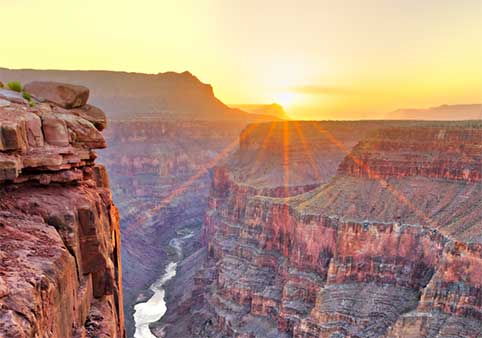
Sunrise at the Grand Canyon begins before the sun appears. The eastern horizon gradually brightens, distant temples become silhouettes, and the canyon walls shift from cool gray and violet to warm shades of gold, orange and red. Within minutes, light reaches deeper formations and reveals details that were invisible in the predawn darkness.
You do not need to find a secret overlook to enjoy it. The best Grand Canyon sunrise viewpoint is the one you can reach safely before dawn without losing the experience to parking problems, shuttle confusion or an unnecessarily long drive.
For most South Rim visitors, Yaki Point is the best overall sunrise viewpoint, Mather Point is the easiest, and Desert View is the strongest choice for visitors entering through the park's East Entrance. Yavapai Point works especially well for guests staying in Grand Canyon Village, while Navajo Point offers a quieter alternative along Desert View Drive.
Best Grand Canyon Sunrise Viewpoint Overall
Choose Yaki Point for unobstructed eastern views, excellent early light on the South Kaibab Trail area and an atmosphere that feels quieter because private vehicles cannot drive directly to the overlook.
Choose Mather Point instead when easy parking, a short walk and uncomplicated logistics matter more than avoiding crowds.
Arrive Before the Sun Appears
Plan to reach your viewpoint at least 30 minutes before the published sunrise time. The predawn color and first light on the canyon formations are often more interesting than the moment the sun clears the horizon.
Temperatures can be surprisingly cold before dawn, including during summer. Bring warm layers and a flashlight or headlamp.
| Sunrise Viewpoint | Best For | Access | Typical Crowd Level |
|---|---|---|---|
| Yaki Point | Best overall sunrise experience | Shuttle, bicycle or walking | Moderate |
| Mather Point | Easiest sunrise for first-time visitors | Short walk from major parking lots | High |
| Yavapai Point | Village lodging and geology views | Shuttle, walking or limited nearby parking | Moderate |
| Desert View | East Entrance arrivals and wide eastern views | Private vehicle | Low to Moderate |
| Navajo Point | Quieter Desert View Drive sunrise | Private vehicle | Low |
| Grandview Point | Dramatic ridges and photography | Private vehicle | Low to Moderate |
| Hopi Point | Wide panorama when Hermit Road access works | Season-dependent shuttle or vehicle access | Moderate |
The Best Places to Watch Sunrise at the Grand Canyon
1. Yaki Point: Best Overall Sunrise Viewpoint
Yaki Point earns the top position because its view opens toward the east, where the rising sun silhouettes prominent formations before illuminating O'Neill Butte, the South Kaibab Trail and the surrounding canyon walls. The viewpoint projects far enough into the canyon to provide broad views in several directions without buildings or large parking areas dominating the setting.
Private vehicles are not permitted at Yaki Point. Most visitors reach it aboard the Kaibab Rim Route, also called the Orange Route, from the Grand Canyon Visitor Center. The lack of private traffic makes the overlook feel more peaceful than Mather Point, although the shuttle requirement adds an extra planning step.
Choose Yaki Point when:
You want the strongest combination of eastern exposure, photography potential and a quieter setting.
Do not choose Yaki Point when:
The first shuttle will not get you there early enough for the sunrise you plan to watch. Shuttle schedules change seasonally, so compare the current first departure with that day's sunrise time rather than assuming service begins before dawn.
2. Mather Point: Easiest for First-Time Visitors
Mather Point is the simplest sunrise choice for most people staying outside the park or arriving by car before dawn. It is located near the Grand Canyon Visitor Center and within a short walk of several large parking areas. That accessibility removes much of the uncertainty from an early-morning outing.
The overlook provides a broad, classic Grand Canyon panorama with long views in both directions. Multiple viewing platforms and nearby stretches of the Rim Trail also make it possible to move away from the busiest cluster of visitors after the first light appears.
The tradeoff is popularity. Tour groups, photographers and first-time visitors often gather here before sunrise, particularly during summer, holidays and weekends. Arrive early enough to walk beyond the first viewing platform when you prefer a little breathing room.
Choose Mather Point when:
You want easy parking, minimal walking and a dependable first-time sunrise plan.
Do not choose Mather Point when:
Avoiding crowds matters more than convenience.
3. Yavapai Point: Best Near Grand Canyon Village
Yavapai Point is an excellent alternative for visitors staying at an in-park lodge or campground. Its central location makes it reachable by shuttle, bicycle or a walk along the Rim Trail from parts of Grand Canyon Village and the Visitor Center area.
The view is especially useful for understanding the canyon's geology. From the overlook, visitors can look across broad sections of the inner canyon and identify prominent formations as the morning light begins separating the rock layers.
Yavapai is not as directly oriented toward the rising sun as Yaki Point, but that can work in a photographer's favor. Instead of pointing the camera into the brightest part of the sky, you can photograph the warm light spreading across formations farther west.
Choose Yavapai Point when:
You are staying inside the park, want to combine sunrise with a Rim Trail walk or prefer illuminated canyon walls over a direct view of the sun.
4. Desert View: Best for East Entrance Visitors
Desert View is the most practical sunrise location for travelers approaching from Cameron, Page, Monument Valley or other destinations east of the park. It sits near the East Entrance, approximately 23 miles from Grand Canyon Village, and can be reached by private vehicle throughout the year unless weather temporarily closes the road.
The landscape here feels more open than the central South Rim. Views extend over the eastern canyon, long sections of the Colorado River and the Painted Desert beyond the park. The Desert View Watchtower adds a distinctive foreground element once daylight begins illuminating its stone walls.
Do not drive from Grand Canyon Village to Desert View solely because it appears on a list of sunrise viewpoints without accounting for the distance. The drive takes roughly 40 minutes in ordinary conditions, and wildlife, darkness, ice or snow can make an early departure slower. Desert View is most sensible when you are already staying nearby or entering from the east.
Choose Desert View when:
You are approaching through the East Entrance or want to begin a morning drive along Desert View Drive.
5. Navajo Point: Best Quiet Alternative Near Desert View
Navajo Point provides many of the advantages of Desert View with fewer visitor services and usually fewer people. Located just west of the Watchtower, it offers an elevated perspective across the eastern canyon and a clear view of the Watchtower from a distance.
This is a particularly good choice for photographers who want to incorporate the tower into the landscape rather than photograph from directly beside it. Because visitors can drive to the overlook, access is straightforward once you are already traveling along Desert View Drive.
There are no substantial indoor facilities at the viewpoint, so bring everything you need for a cold predawn wait. Desert View's restrooms and visitor services are nearby but may not all be open at sunrise.
Choose Navajo Point when:
You want eastern canyon scenery, direct vehicle access and a quieter setting near Desert View.
6. Grandview Point: Best for Ridges and Dramatic Layers
Grandview Point looks across a complex landscape of ridges, side canyons and distant formations. As morning light moves across the scene, the overlapping landforms create strong shadows and visual depth that work especially well in photographs.
The viewpoint is accessible by private vehicle along Desert View Drive and is closer to Grand Canyon Village than Desert View or Navajo Point. This makes it a practical compromise for visitors who want a less crowded sunrise without driving to the eastern end of the park.
The parking area is smaller than the lots near Mather Point. Arriving early improves your chance of finding a convenient space and gives your eyes time to adjust before walking toward the rim.
Choose Grandview Point when:
You want a quieter sunrise, dramatic landforms and direct vehicle access within a reasonable drive of Grand Canyon Village.
7. Hopi Point: A Panoramic but Less Predictable Choice
Hopi Point is famous for sunset, but its broad panorama also makes it a rewarding sunrise location. The overlook projects into the canyon and provides wide views in both directions, along with several glimpses of the Colorado River.
Its main drawback is access. During much of the year, Hermit Road is closed to private vehicles and served by the Hermits Rest Route shuttle. That route may not begin early enough for sunrise, depending on the season. In winter, private vehicles are generally allowed when road conditions permit, making Hopi Point a more practical dawn destination.
Hopi Point should therefore be treated as a season-dependent option rather than the default recommendation. Verify both the current road rules and shuttle schedule before building an early-morning plan around it.
Choose Hopi Point when:
Access is available before dawn and you want one of the widest panoramas along the South Rim.
How to Choose the Right Sunrise Viewpoint
Best Viewpoint by Visitor Type
| Your Priority | Best Choice | Why |
|---|---|---|
| Best overall experience | Yaki Point | Strong dawn views without private vehicle traffic |
| Easiest parking and access | Mather Point | Large nearby parking areas and a short walk |
| Staying in Grand Canyon Village | Yavapai Point | Convenient for walking, bicycling or shuttle access |
| Entering from Page or Cameron | Desert View | Located near the East Entrance |
| Fewer crowds | Navajo Point | Quiet setting with private-vehicle access |
| Landscape photography | Yaki or Grandview Point | Strong silhouettes, ridges and morning shadows |
| Winter sunrise | Mather or Hopi Point | Vehicle access may be easier, depending on road conditions |
Sunrise Direction Changes During the Year
The sun does not rise in exactly the same place every day. It appears farther north along the horizon around summer and farther south during winter. This changes which canyon formations are silhouetted and where the first light lands.
You do not need specialized equipment to account for this. Arrive early, explore the viewing area and watch where the horizon begins to brighten. Photographers using tripods may benefit from checking the sunrise direction in advance rather than choosing a composition in complete darkness.
Direct Sunrise Views vs. Light on the Canyon
Watching the sun cross the horizon is only one way to experience sunrise. Pointing directly east can produce silhouettes and colorful skies, but the brightest area may overwhelm details inside the canyon.
Some of the best photographs are made by turning away from the sun and capturing the first warm light on formations to the west. Yavapai Point, Grandview Point and portions of the Rim Trail are especially useful for this approach.
When clouds cover the eastern horizon, remain patient. The sun may break through several minutes later and send concentrated beams of light across the canyon. Sunrise is a sequence, not a single scheduled moment.
```htmlPlanning Your Grand Canyon Sunrise Visit
When Should You Arrive?
One of the biggest mistakes first-time visitors make is arriving at sunrise instead of before it. The Grand Canyon begins changing long before the sun clears the horizon.
Plan to arrive at your chosen viewpoint at least 30 to 45 minutes before the published sunrise time. This gives you enough time to park, walk safely to the overlook, allow your eyes to adjust to the darkness and enjoy the gradual transition from night to dawn.
The first glow often appears along the eastern horizon well before sunrise. As the light increases, canyon walls slowly emerge from shadow and the rock formations take on subtle shades of blue, purple and gray before warming into reds and golds.
What Should You Bring?
Even during midsummer, mornings at the South Rim can feel surprisingly cool. Temperatures before sunrise are often 20 to 30 degrees colder than afternoon highs.
- Warm jacket or fleece
- Flashlight or headlamp
- Water bottle
- Camera with extra batteries
- Tripod for photography
- Gloves and hat during cooler months
If you're photographing sunrise, arrive early enough to set up your equipment before other visitors gather along the overlook.
Seasonal Considerations
Sunrise changes dramatically throughout the year.
Spring
Comfortable temperatures and relatively clear mornings make spring one of the most popular seasons for sunrise photography.
Summer
Expect the earliest sunrise times of the year. Afternoon thunderstorms are common, but mornings are often calm and clear.
Fall
Cooler temperatures, fewer visitors and excellent visibility make autumn a favorite season for many photographers.
Winter
Snow along the rim can transform the landscape into one of the Grand Canyon's most spectacular sights. Later sunrise times also make winter easier for visitors who don't enjoy very early mornings.
Sunrise Safety Tips
Walking near the canyon rim before daylight requires extra awareness.
- Stay on paved paths and designated trails.
- Carry a flashlight until daylight is sufficient.
- Remain behind railings and barriers.
- Watch for icy sidewalks during winter.
- Dress for changing temperatures.
- Give photographers using tripods plenty of room.
The Grand Canyon is beautiful at dawn, but it is still wilderness. Taking a few extra precautions helps ensure your morning begins safely.
Sample Sunrise Itineraries
Best First-Time Visitor Morning
- Arrive at Mather Point 45 minutes before sunrise.
- Watch sunrise.
- Walk a section of the Rim Trail toward Yavapai Point.
- Visit Yavapai Geology Museum.
- Enjoy breakfast in Grand Canyon Village.
Best Photography Morning
- Take the earliest available access to Yaki Point.
- Photograph first light.
- Walk portions of the South Kaibab Trail overlook area.
- Continue to Yavapai Point after sunrise for changing light.
Best East Entrance Morning
- Watch sunrise at Desert View.
- Explore Desert View Watchtower.
- Drive Desert View Drive west, stopping at Navajo Point, Lipan Point, Moran Point and Grandview Point.
- Arrive in Grand Canyon Village by late morning.
Grand Canyon Sunrise FAQs
Where is the best place to watch sunrise at the Grand Canyon?
Yaki Point is generally considered the best overall sunrise viewpoint because of its unobstructed eastern exposure and outstanding views of the South Kaibab area. Mather Point is the easiest option for most first-time visitors.
What time should I arrive before sunrise?
Plan to arrive at least 30 to 45 minutes before the published sunrise time to enjoy the changing colors before the sun reaches the horizon.
Is Mather Point or Yaki Point better for sunrise?
Yaki Point offers a better sunrise experience with fewer vehicles nearby, while Mather Point is easier to reach and has more convenient parking.
Can you drive to Yaki Point?
No. Private vehicles are generally not permitted. Visitors reach Yaki Point by shuttle, bicycle or on foot.
Is sunrise or sunset better at the Grand Canyon?
Both are spectacular. Sunrise generally offers cooler temperatures, calmer conditions and fewer visitors, while sunset often produces richer colors and larger crowds.
Is Desert View good for sunrise?
Yes. Desert View is one of the best sunrise locations for visitors entering through the East Entrance and offers beautiful views of the eastern Grand Canyon.
Do I need a reservation for sunrise?
No reservation is required to watch sunrise. Normal Grand Canyon National Park entrance fees apply.
What should I wear for sunrise?
Dress in layers. Even during summer, early morning temperatures at the South Rim can be chilly before the sun rises.
Explore More Grand Canyon Viewpoints
- Best Grand Canyon Viewpoints
- Yaki Point Visitor Guide
- Mather Point Visitor Guide
- Yavapai Point Visitor Guide
- Desert View Watchtower Guide
- Navajo Point Visitor Guide
- Grandview Point Visitor Guide