Navajo Point is the highest developed overlook on the Grand Canyon South Rim, standing at 7,461 feet above sea level. Located near the eastern end of Desert View Drive, it offers panoramic canyon views, a long look north along the Colorado River and one of the best distant perspectives of Desert View Watchtower.
The viewpoint is only a few minutes west of the Desert View developed area, but it feels considerably simpler. There is a small parking area and scenic overlook without the stores, restrooms and visitor facilities found around the Watchtower.
Navajo Point is especially rewarding for travelers driving Desert View Drive, photographers interested in the Watchtower and visitors seeking a quieter alternative to the busier Desert View overlook.
Why Visit Navajo Point?
Navajo Point combines the highest developed overlook on the South Rim with direct views of the Colorado River and a striking profile of Desert View Watchtower.
Visit Navajo Point before Desert View when driving east, or stop here immediately after the Watchtower when traveling west toward Grand Canyon Village.
Limited Visitor Services
Navajo Point has parking and a scenic overlook, but no food service, drinking water or public restroom facilities.
Restrooms, water, food, shops and other visitor services are available a few minutes east at Desert View.
| Navajo Point at a Glance | What to Know |
|---|---|
| Location | Mile Marker 264 on Desert View Drive |
| Elevation | 7,461 feet above sea level |
| Known for | Highest developed South Rim overlook, Colorado River views and Watchtower photography |
| Access | Private vehicle, bicycle or organized tour |
| Parking | Small parking area beside the overlook |
| Shuttle service | No regular park shuttle service |
| Restrooms | Not available; use facilities at Desert View |
| Drinking water | Not available |
| Best time | Morning, late afternoon and sunset |
| Typical visit | 20 to 45 minutes; longer for photography or sunset |
What to See at Navajo Point
The Highest Developed Overlook on the South Rim
At 7,461 feet, Navajo Point is the highest developed scenic overlook on the South Rim. It stands slightly higher than the surrounding Desert View Drive viewpoints, although visitors who climb to the upper observation levels of Desert View Watchtower can reach a higher viewing position.
The added elevation contributes to Navajo Point’s broad western panorama and long view toward the Colorado River. It can also mean stronger wind, colder temperatures and lingering snow or ice during winter.
The elevation difference between Navajo Point and nearby overlooks may not feel dramatic from the parking area, but it becomes more apparent when looking across the canyon’s descending ridges and distant plateaus.
Colorado River Views
Navajo Point provides an expansive view north along the Colorado River as it winds through the eastern Grand Canyon. The river appears between steep inner-canyon walls and layered rock formations far below the rim.
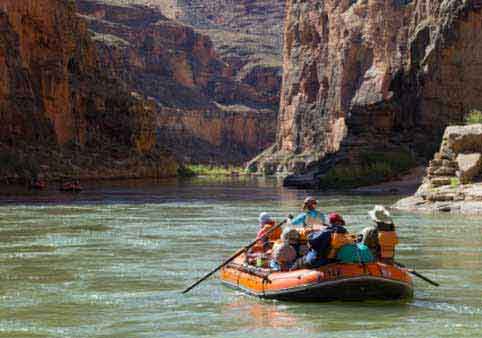
Watch carefully for whitewater rafts. Even large boats appear tiny from the overlook, so binoculars or a telephoto lens are useful.
The eastern canyon is wider and more open than many central South Rim views. This makes it easier to follow sections of the river corridor and understand how the canyon transitions toward Marble Canyon and the Painted Desert region.
Views of Desert View Watchtower
Navajo Point provides one of the best exterior views of Desert View Watchtower. From the overlook, the stone tower rises above the forested rim to the east and forms a distinct silhouette against the sky.
The perspective is particularly useful for photography because visitors can see the Watchtower as part of the surrounding landscape rather than only from its immediate plaza.
A normal camera lens can capture the Watchtower within the larger panorama. A telephoto lens makes it possible to isolate the tower, nearby cliffs and changing light along the rim.
Plan your visit to Desert View Watchtower »
Panoramic Views to the West
The overlook opens westward across a broad section of the canyon toward distant temples, buttes and side canyons. Morning and late-afternoon light reveal different layers of the landscape.
On clear days, the view can extend across numerous formations toward the central South Rim. Haze, smoke, clouds and seasonal weather may reduce distant visibility.
Navajo Point also provides a useful visual transition between the open eastern canyon around Desert View and the narrower perspectives found farther west along Desert View Drive.
Grand Canyon Supergroup Rocks
Navajo Point and nearby Lipan Point provide views of tilted formations belonging to the Grand Canyon Supergroup.
These ancient rock layers differ from the more familiar horizontal bands visible throughout much of Grand Canyon. They were tilted, faulted and partially eroded before younger sedimentary layers accumulated above them.
The formations can be difficult to identify without a map or geology guide, but their angles and darker colors help distinguish them from surrounding horizontal cliffs.
Learn how the Grand Canyon’s rock layers formed »
The 1956 Aviation Accident Memorial
Navajo Point contains a stone memorial and plaque commemorating the 1956 collision of TWA Flight 2 and United Airlines Flight 718 over Grand Canyon.
The two aircraft collided on June 30, 1956, killing all 128 people aboard. At the time, it was the deadliest commercial aviation accident in United States history.
The disaster exposed serious limitations in the nation’s air traffic control system and contributed to major changes in federal aviation oversight. The accident sites were later recognized as a National Historic Landmark.
The memorial gives Navajo Point a solemn historical dimension that distinguishes it from the other scenic overlooks along Desert View Drive. Visitors should approach the site respectfully and avoid climbing on the stone monument.
Is Navajo Point Worth Visiting?
Yes. Navajo Point is worth visiting for its elevation, Colorado River visibility, Watchtower views and convenient roadside access.
It is particularly well suited to:
- Visitors driving the full length of Desert View Drive
- Photographers seeking an exterior view of Desert View Watchtower
- Travelers interested in seeing the Colorado River from the rim
- Visitors looking for a quieter stop near Desert View
- Travelers interested in Grand Canyon geology
- Visitors learning about the 1956 aviation accident
Travelers with extremely limited time may choose Desert View instead because it combines canyon views with restrooms, food, shops and the Watchtower. Navajo Point is better for a quieter and more landscape-focused experience.
Navajo Point vs. Desert View
| Navajo Point | Desert View |
|---|---|
| Highest developed South Rim overlook | Home of Desert View Watchtower |
| Quieter roadside viewpoint | Busy developed visitor area |
| Best distant exterior view of the Watchtower | Best access to the Watchtower itself |
| No restrooms, food or water | Restrooms, water, food and shops available |
| Usually a shorter stop | Can occupy one to two hours |
| Small parking area | Large automobile and RV parking areas |
Choose Navajo Point for a quieter overlook, panoramic photography and an exterior Watchtower view. Choose Desert View for visitor services, cultural interpretation and entry into the Watchtower when available.
The two stops are close enough that most visitors driving Desert View Drive should experience both.
Navajo Point vs. Lipan Point
| Navajo Point | Lipan Point |
|---|---|
| Highest developed South Rim overlook | Known for an extensive Colorado River panorama |
| Excellent Watchtower view | Better views toward the Painted Desert and San Francisco Peaks |
| Aviation accident memorial | Strong geology and river interpretation |
| Very close to Desert View | Farther west along Desert View Drive |
| Strong sunrise and sunset potential | Strong sunrise, sunset and river photography |
Choose Navajo Point for elevation, the Watchtower and a quieter Desert View companion stop. Choose Lipan Point when a long, unobstructed Colorado River view is the main priority.
Sunrise, Sunset and Photography
Sunrise at Navajo Point
Navajo Point is a strong sunrise location because the eastern horizon and surrounding canyon are broadly visible.
Early light can illuminate the rim around Desert View Watchtower before reaching the deeper canyon. Depending on clouds and atmospheric conditions, the tower may appear as a silhouette or catch warm morning light.
Arrive at least 30 minutes before sunrise. There is no shuttle to Navajo Point, so visitors must drive themselves or use an authorized tour or transportation service.
Use caution when driving Desert View Drive before daylight. Wildlife, ice, snow, fog and limited visibility can create hazards.
Sunset at Navajo Point
Navajo Point is often popular at sunset because it provides both eastern and western panoramas.
Late-afternoon light can illuminate western canyon formations while the Watchtower takes on a warm profile to the east. After the sun drops, the eastern sky may develop softer color behind the tower.
The viewpoint can become busy near sunset, and parking is limited. Arrive 45 to 60 minutes early during summer, weekends and holidays.
Bring warm clothing and a headlamp. The high elevation can produce cold wind even when daytime temperatures are comfortable.
Best Photography Opportunities
Desert View Watchtower profile
Photograph the tower rising above the forested rim to the east. Morning and evening light typically provide more texture than midday.
Colorado River corridor
Use a telephoto lens to isolate the river, whitewater and boats far below.
Wide western panorama
A wide-angle lens can capture the openness of the eastern canyon and its layered formations.
Grand Canyon Supergroup
Look for angled rock layers that contrast with the canyon’s more familiar horizontal strata.
Night sky
Navajo Point is removed from the brighter developed areas of Grand Canyon Village, although headlights and arriving vehicles may interrupt long exposures.
Photography Safety
- Remain behind railings and away from unstable edges.
- Do not step backward while looking through a camera.
- Keep tripods out of vehicle lanes and walking paths.
- Carry a headlamp before sunrise and after sunset.
- Secure hats, lens caps and lightweight equipment in strong wind.
- Do not climb on the aviation memorial or protected structures.
Weather and Seasonal Conditions
Navajo Point is exposed to intense sun, wind, thunderstorms, snow and ice.
Summer thunderstorms can develop quickly. Leave exposed overlooks when thunder is nearby and avoid standing beside isolated trees, railings or other conductive objects.
Winter storms may temporarily close Desert View Drive or make the parking area and paths icy. Conditions at Navajo Point may be colder and windier than at lower elevations outside the park.
Check current road and weather conditions before traveling, particularly from November through March.
Parking, Accessibility and Visit Planning
How to Reach Navajo Point
Navajo Point is located at Mile Marker 264 on Desert View Drive, also designated Arizona State Route 64.
From Grand Canyon Village, travel east on Desert View Drive toward the park’s East Entrance. Navajo Point is one of the final developed overlooks before Desert View.
From Cameron and the East Entrance, continue west through the Desert View developed area. Navajo Point is only a few minutes farther along the road.
There is no regular National Park Service shuttle along Desert View Drive. Visitors must use a private vehicle, bicycle, organized tour or other authorized transportation.
Parking
A small parking area is available beside the overlook. Spaces can fill near sunset and during peak travel periods.
The lot is considerably smaller than the main parking areas at Desert View. Large RVs, buses and vehicles towing trailers may have limited maneuvering room when the overlook is crowded.
Park only in designated spaces. Do not block traffic, park on vegetation or stop in the travel lane while waiting for a space.
Accessibility
Navajo Point includes parking close to the scenic viewing area. The developed overlook can provide canyon and Colorado River views without a long hike.
Surface conditions, slopes, snow, ice and temporary obstructions may affect individual accessibility. The National Park Service accessibility guide identifies views of the Colorado River and Grand Canyon Supergroup rocks from the Navajo Point area.
Visitors with specific mobility needs should confirm current conditions with a ranger or visitor center before traveling.
Restrooms, Food and Water
Navajo Point does not offer restrooms, drinking water or food service.
The nearby Desert View developed area provides:
- Public restrooms
- Drinking-water access
- A market and deli
- Seasonal refreshments
- Park stores
- Gasoline available by credit or debit card
Hours vary by season. Carry water in your vehicle even when planning to use Desert View services.
Pets
Leashed pets are generally permitted in developed areas and on designated trails above the rim. Pets must remain under control, and owners must remove all waste.
Do not leave pets unattended in vehicles. Interior temperatures can become dangerous even when rim temperatures feel moderate.
Visiting with Children
Navajo Point can be a convenient family stop because the overlook is close to the parking area and does not require a strenuous walk.
- Keep children within reach near the rim.
- Do not allow climbing or sitting on barriers.
- Watch for moving vehicles in the small parking area.
- Bring water, snacks and warm layers.
- Do not permit children to climb on the aviation memorial.
How Long Should You Spend at Navajo Point?
Allow approximately 20 to 45 minutes for a typical visit.
Plan 60 to 90 minutes for sunrise, sunset or more deliberate photography. Add time for parking during busy periods.
Navajo Point works well as part of a half-day Desert View Drive itinerary rather than as a standalone destination.
Suggested Desert View Drive Itinerary
A practical eastbound itinerary from Grand Canyon Village is:
- Grandview Point
- Moran Point
- Tusayan Pueblo site
- Lipan Point when open
- Navajo Point
- Desert View Watchtower and visitor services
Visitors entering through the East Entrance can reverse the order and experience Navajo Point shortly after Desert View.
Plan the complete Desert View Drive route »
Nearby Places to Visit
Desert View Watchtower
A landmark Mary Colter structure with canyon views, cultural interpretation and seasonal access to its upper levels.
Lipan Point
A major eastern South Rim overlook known for long Colorado River views, geology and broad vistas toward the Painted Desert.
Tusayan Pueblo
An ancestral Puebloan site that helps visitors understand the region’s long human history.
Moran Point
A colorful overlook where visitors can see the Colorado River and distinctive geological formations.
Grandview Point
A high panoramic overlook associated with historic mining and the steep Grandview Trail.
Read the Grandview Point visitor guide »
Navajo Point FAQs
Is Navajo Point worth visiting?
Yes. Navajo Point combines the highest developed overlook on the South Rim with Colorado River views, a quieter atmosphere and one of the best exterior views of Desert View Watchtower.
Is Navajo Point the highest viewpoint on the South Rim?
Navajo Point is the highest developed scenic overlook on the South Rim at 7,461 feet. The upper observation levels of Desert View Watchtower provide a higher viewing position when they are open.
Can you see the Colorado River from Navajo Point?
Yes. Navajo Point provides an expansive view north along the Colorado River. Binoculars can help visitors locate whitewater and rafting boats far below.
Can you see Desert View Watchtower from Navajo Point?
Yes. Navajo Point provides one of the best distant exterior views of Desert View Watchtower rising above the forested South Rim.
Can you drive to Navajo Point?
Yes. Navajo Point is reached by private vehicle along Desert View Drive. The road is generally open year-round but may close temporarily because of snow, ice or other hazards.
Does the Grand Canyon shuttle go to Navajo Point?
No. Regular National Park Service shuttle buses do not operate along Desert View Drive. Visitors need a private vehicle, bicycle, organized tour or other authorized transportation.
Is there parking at Navajo Point?
Yes. A small parking area is located beside the viewpoint. It can fill near sunset and during busy travel periods.
Are there restrooms at Navajo Point?
No. Restrooms are available a few minutes east in the Desert View developed area.
Is drinking water available at Navajo Point?
No. Bring water or use the visitor facilities available at Desert View.
Is Navajo Point good for sunset?
Yes. Navajo Point offers broad eastern and western views, evening light across the canyon and a strong Watchtower silhouette. Arrive early because parking is limited.
Is Navajo Point good for sunrise?
Yes. Its eastern exposure provides sunrise views and early light around Desert View Watchtower. Visitors must drive because regular shuttle service is not available.
What is the memorial at Navajo Point?
The stone memorial commemorates the June 30, 1956 collision of TWA Flight 2 and United Airlines Flight 718 over Grand Canyon, which killed all 128 people aboard.
How long should you spend at Navajo Point?
Allow 20 to 45 minutes for a typical stop. Plan 60 to 90 minutes for sunrise, sunset or photography.
Explore More Grand Canyon Viewpoints
- Best Grand Canyon Viewpoints
- Mather Point Visitor Guide
- Yavapai Point and Geology Museum
- Hopi Point Sunset Guide
- Yaki Point Visitor Guide
- Mohave Point Visitor Guide
- Grandview Point Visitor Guide
- Point Imperial Visitor Guide
- Cape Royal Visitor Guide